

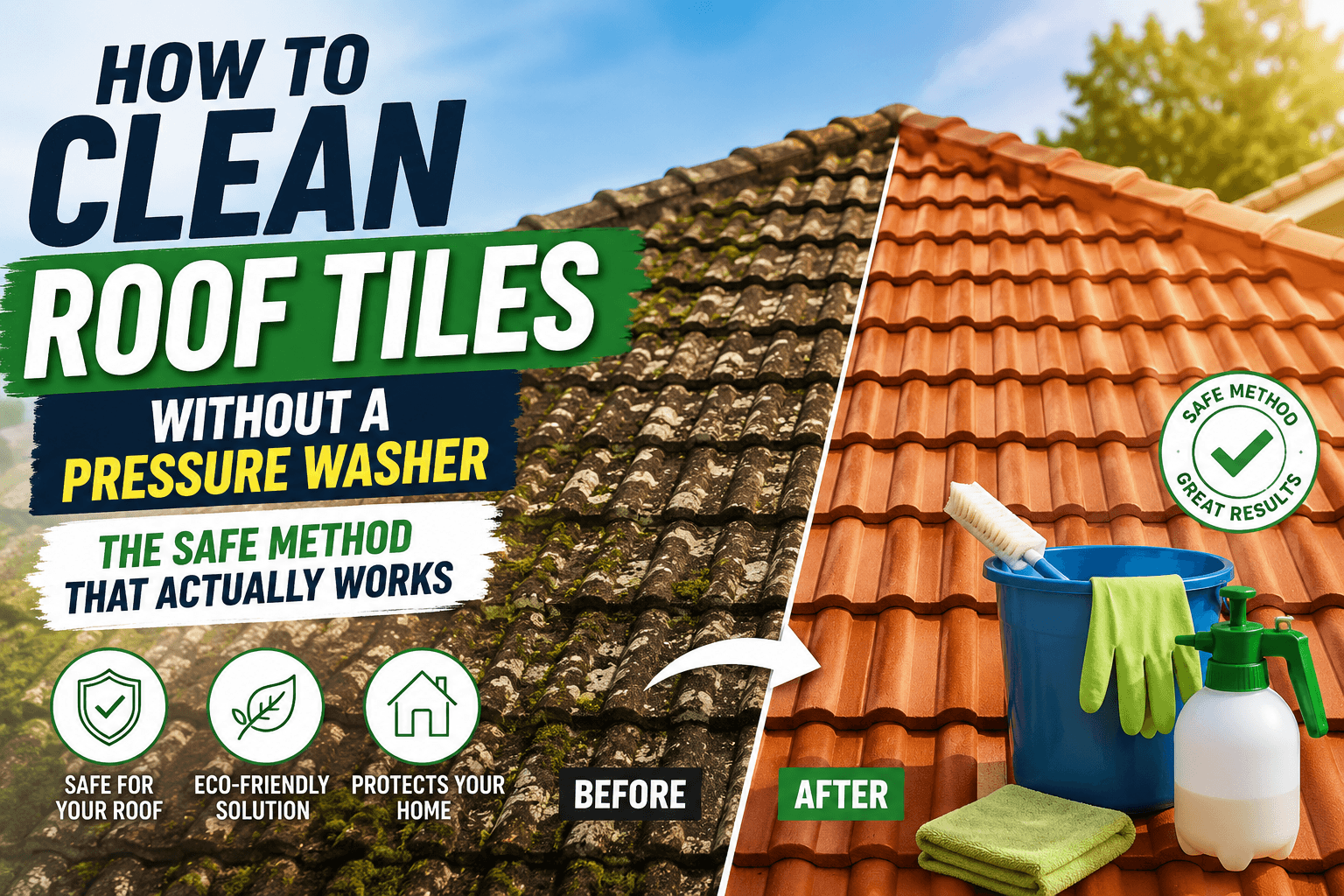
Pressure washing a roof might seem like the fastest solution, but for many tile types it’s one of the quickest ways to cause serious, expensive damage. Here’s how to get a genuinely clean roof without touching a pressure washer.
Perth roofs take a beating. The UV intensity, coastal salt air, summer dust storms, and periodic heavy rain create the ideal conditions for lichen, moss, algae, and grime to colonise roof tiles year after year. The result is a roof that looks decades older than it is and one that may be quietly degrading underneath that biological growth.
But before you hire a pressure washer, it’s worth understanding why that approach often does more harm than good on roof tiles and what the professional alternative actually looks like.
Why you shouldn’t pressure wash most roof tiles
Unlike driveways or warehouse floors, roof tiles are not designed to withstand high-pressure water. Terracotta and concrete tiles have a protective surface coating that erodes under excessive PSI, leaving the tile porous, brittle, and far more vulnerable to future moss and lichen growth.
Colorbond and metal roofing is at risk of denting and paint stripping. Older cement tiles extremely common across Perth’s established suburbs can crack or shatter under direct high-pressure spray. And regardless of tile type, pressure washing forces water up under the tiles and into the battens and sarking beneath, creating moisture problems that can take months to reveal themselves as leaks.
In Perth, many insurance assessors will flag roof damage caused by pressure washing as maintenance negligence. This can affect claims related to water ingress or tile failure. Always check your policy before pressure washing a roof.
The good news is that soft washing and manual chemical treatment done correctly produces results that equal or outperform pressure washing, without the risk.
What you’ll need before you start
Cleaning roof tiles without a pressure washer requires a different set of equipment. For a DIY approach on a small, single-storey section:
- Soft-bristle brush or long-handled scrubbing brush
- Garden hose with adjustable nozzle (low-flow setting only)
- Biocide or algaecide roof cleaning solution (available from roofing suppliers)
- Pump garden sprayer for chemical application
- Non-slip rubber-soled footwear rated for roof work
- Safety harness non-negotiable for anything above single storey
Roof work carries a genuine fall risk. In Western Australia, any roof work at height requires appropriate safety equipment. If your roof is steep-pitched, multi-storey, or you’re uncomfortable working at height, this is a job for a licensed professional not a DIY project.
Step-by-step: how to clean roof tiles without a pressure washer
Step 1
Clear debris first
Remove leaves, twigs, and organic debris by hand or with a soft brush. Never use a metal rake — it scratches tile surfaces.
Step 2
Apply biocide solution
Spray a roof-appropriate biocide or algaecide evenly across the tiles using a pump sprayer. Work from the ridge down.
Step 3
Allow dwell time
Let the solution sit for the manufacturer’s recommended dwell time — typically 20–45 minutes. Avoid applying in direct sun or strong wind.
Step 4
Gentle scrubbing
Work with a soft-bristle brush on heavily affected areas. Always scrub down the tile slope, never across or up against the overlaps.
Step 5
Low-pressure rinse
Rinse from ridge to eave using a garden hose on a gentle flow. Never aim upward into tile overlaps — water follows the tile direction only.
Step 6
Apply protective treatment
Once dry, apply a roof sealer or moss inhibitor to slow regrowth. This significantly extends the interval before the next clean is needed.
Which roof tile types can be cleaned without a pressure washer?
Terracotta tiles Safe
Responds very well to soft washing and biocide treatment. Chemical method preferred preserves the protective glaze.
Concrete tiles Safe
Porous surface benefits from biocide treatment. Soft brush and low-flow rinse work well. Seal after cleaning to reduce future moss growth.
Cement tiles Safe
Older cement tiles are brittle chemical treatment is significantly safer than any pressure. Manual scrubbing only on localised spots.
Colorbond / metal Careful
Generally lower maintenance, but still benefits from annual rinse and biocide. Avoid abrasive brushes — use soft cloth or sponge only.
The role of biocide — why chemical treatment outperforms scrubbing alone
Moss, lichen, and algae don’t just sit on top of tiles they anchor into the surface at a microscopic level. Scrubbing removes the visible growth but leaves the root structures (rhizines for lichen, rhizoids for moss) embedded in the tile.
Without a biocide treatment, regrowth returns within months rather than years. A quality roof algaecide penetrates the surface and kills growth at the root, meaning treated tiles stay cleaner for significantly longer than those that are simply scrubbed or rinsed.
Professional roof cleaning services use commercial-grade biocides at concentrations not available to the general public one reason professional results tend to last 2–3 years, compared to 6–12 months from a DIY treatment.
Perth-specific considerations: why local conditions matter
Perth’s climate is harder on roofs than most Australian cities. The combination of long UV exposure, coastal salt deposition in western suburbs, and the significant rainfall events during winter creates year-round conditions for biological growth and tile degradation.
Roofs in suburbs within 5–10 km of the coastline Scarborough, Cottesloe, Fremantle, North Beach accumulate salt deposits that accelerate lichen and algae growth and can interact chemically with some tile coatings. Biocide treatment in these areas needs to account for salt removal, not just biological kill.
In the hills areas like Kalamunda and Mundaring, heavy tree coverage produces persistent moisture and heavier organic debris meaning gutters and ridgeline areas need particular attention during cleaning.
When to call a professional roof cleaning service instead
DIY roof cleaning is reasonable for a confident homeowner working on a low-pitched, single-storey roof with minor moss or algae. But a professional service is the right call when:
- The roof is two storeys or has a steep pitch above 25 degrees
- There is significant lichen growth lichen is far harder to remove than moss and usually requires stronger commercial treatment
- Tiles are visibly cracked, lifting, or in poor condition cleaning may reveal damage that needs repair first
- You need the work completed to a standard required for a property sale or insurance assessment
- The roof hasn’t been cleaned in more than 5 years and has heavy biological coverage
Services like Skyline Global Projects bring commercial-strength biocide treatments, proper safety systems for multi-storey and steep-pitch roofs, and the experience to assess tile condition before cleaning begins ensuring the process improves your roof rather than accelerating damage to it.
How often should roof tiles be cleaned in Perth?
As a general guide for Perth conditions:
- Coastal suburbs: every 2–3 years due to accelerated salt and algae buildup
- Inland metro areas: every 3–4 years for concrete and terracotta
- Hills and tree-lined areas: every 2 years, with annual gutter and ridge checks
- Following a biocide treatment with sealer: add 12–18 months to any of the above intervals
Annual visual inspections from ground level looking for dark streaking, green patches, or lifting tiles are worthwhile even if cleaning isn’t yet needed.
Common mistakes to avoid when cleaning roof tiles yourself
- Using a pressure washer on any setting — even “low” settings on domestic units can exceed safe tile PSI
- Scrubbing upward against tile overlaps — forces water under tiles and into the roof structure
- Using household bleach undiluted — can stain tiles, corrode metal flashings, and kill surrounding garden plants
- Cleaning on a hot, sunny day — biocides evaporate too quickly and lose effectiveness before they can penetrate
- Skipping the sealer step — the single biggest factor in how quickly regrowth returns
- Working without proper roof safety equipment — fall injury is the most serious risk in any roof maintenance task
Frequently asked questions
Can I use bleach to clean roof tiles?
Diluted sodium hypochlorite (household bleach at 10–15% concentration) can be used on some concrete and terracotta tiles, but it must be used carefully. It can bleach coloured tiles, corrode zinc flashings and gutters, and damage surrounding plants if it runs off. Commercial roof biocides are a safer and more effective alternative.
How long does it take to clean roof tiles without a pressure washer?
For a standard single-storey Perth home, a DIY soft wash typically takes 3–5 hours including dwell time. A professional service can complete the same job in less time using commercial equipment and higher-strength treatments, usually within a half-day visit.
Will soft washing remove lichen from roof tiles?
Yes, but lichen requires longer dwell times and stronger biocide concentrations than moss or algae. In heavy lichen cases, multiple treatments over several weeks may be needed as the lichen dies and loosens. This is one of the main reasons professional commercial-strength treatments outperform DIY products.
Need your Perth roof cleaned professionally?
Skyline Global Projects provides safe, effective roof cleaning for residential and commercial properties across Perth using soft wash methods, commercial biocides, and proper safety systems for any roof type or pitch.Request a free quote